The Integration Backlog Was Never Going to Be Solved With More APIs
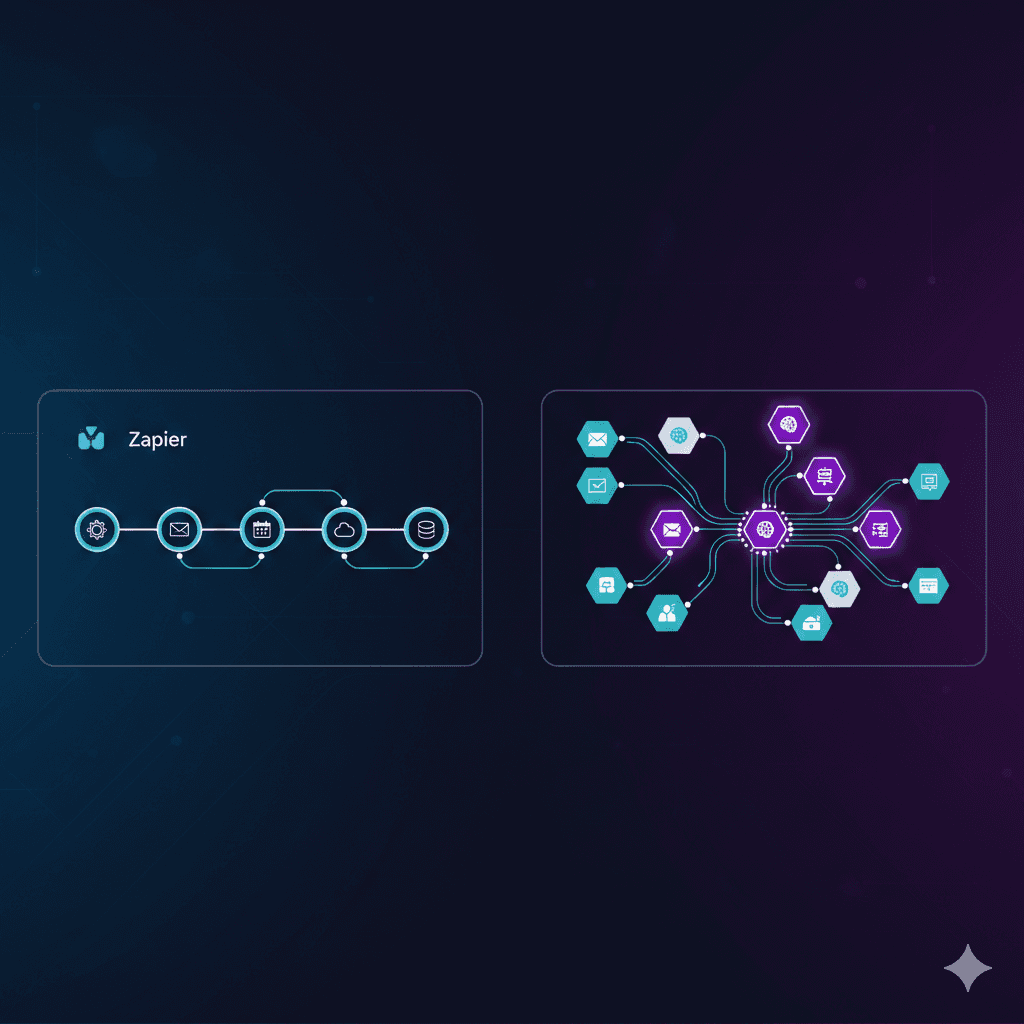
Every IT team is sitting on an integration backlog that grows faster than it can be closed. Traditional REST and webhook plumbing has carried the industry for fifteen years, but the maintenance burden, brittle failure modes, and per-system specialization make scaling impossible past a certain point. The AI integrations vs APIs conversation has moved from theoretical to operational. teams running AI-driven integration patterns in production are reporting 70% reductions in initial build time and meaningful drops in ongoing maintenance.
Here are the five concrete reasons the gap exists, and what it means for IT teams in 2026.
1. Schema Inference Replaces Manual Mapping
1. The Field-Mapping Tax Disappears
A typical integration spends 30-40% of build time on field mapping. translating "customer_id" in one system to "account_ref" in another, handling type coercions, deciding what to do with fields that don't exist on both sides. AI-driven integrations infer mappings from sample data and natural-language descriptions, producing a draft mapping that engineers review rather than build.
2. Resilience to Upstream Changes
Traditional APIs break when an upstream system renames a field or adds a required parameter. AI-driven integrations adapt. they can recognize semantically equivalent fields, handle new optional parameters gracefully, and surface only structural changes that genuinely need human attention. The "API broke at 2am" pages drop substantially.
3. Natural Language Configuration
"When a high-priority ticket comes in from a strategic account, route it to the senior on-call and notify the account manager." That's a workflow spec a non-engineer can write. Traditional integration code requires translating that into webhook configuration, conditional logic, and authentication boilerplate. AI-driven integration platforms compile the natural-language spec into running workflows directly.
4. Better Handling of Unstructured Data
A massive share of "integration" work involves unstructured or semi-structured data. PDFs, emails, free-text fields, document attachments. Traditional APIs handle this poorly because there's no consistent schema. AI integrations parse, classify, and normalize unstructured data as part of the integration itself, replacing fragile regex pipelines with semantic understanding.
5. Self-Documenting and Self-Diagnosing Workflows
Traditional integration documentation rots. AI-driven integrations describe themselves. what they do, what they connect, what their last 100 runs looked like, why a particular error happened. When something fails, the system explains the failure in plain language with proposed fixes. Engineers stop spelunking through logs to debug routine integration breakage.
Where Traditional APIs Still Win
The honest answer in the AI integrations vs APIs debate: traditional APIs still win on raw throughput, sub-millisecond latency, and strict deterministic behavior. High-frequency trading, payment processing, and other tight-SLA paths should keep their direct API integrations. Most enterprise integration work. the long tail of internal tools, vendor connections, and operational workflows. does not have those constraints and benefits from AI-driven approaches.
The 70% Build-Time Number Explained
The 70% reduction comes from compounding savings:
Schema mapping: 30-40% of traditional build time, reduced to review-only
Authentication and retry logic: pre-built in modern AI workflow platforms
Documentation: generated automatically from the workflow definition
Test scaffolding: synthesized from the workflow spec
Initial monitoring and alerting: included by default
What used to be a three-week integration becomes a four-day integration with the engineer focused on edge cases rather than boilerplate.
How to Pilot AI-Driven Integration Without Betting the Backlog
Pick one integration on the current backlog with these characteristics: not on the critical path, involves at least one system with messy data, has gone through one upstream API change in the last year. Build it both ways, in parallel, and measure end-to-end build time, lines of maintained code, and resilience to a simulated upstream change. The data will tell the story.
Frequently Asked Questions
Are AI integrations production-grade?
Yes, when deployed on platforms with proper observability, retry logic, and human-in-the-loop checkpoints. The maturity gap that existed in 2024 has largely closed.
Do AI integrations cost more to run?
Compute costs are higher per call, but total cost of ownership is lower because of the dramatically reduced maintenance burden. Most teams break even within the first quarter.
What about security and compliance?
Per-workflow credentials, audit logging, and data residency controls are standard on enterprise AI integration platforms. The compliance posture matches or exceeds traditional integration approaches.
How does Innflow approach AI integrations vs APIs?
Innflow combines both. AI-driven workflow primitives for the long tail of integrations where flexibility matters, with deterministic API connectors where strict SLAs require it. IT teams get the right tool for each integration without managing two platforms.