Zapier Was Built for a Different Era. and It Shows
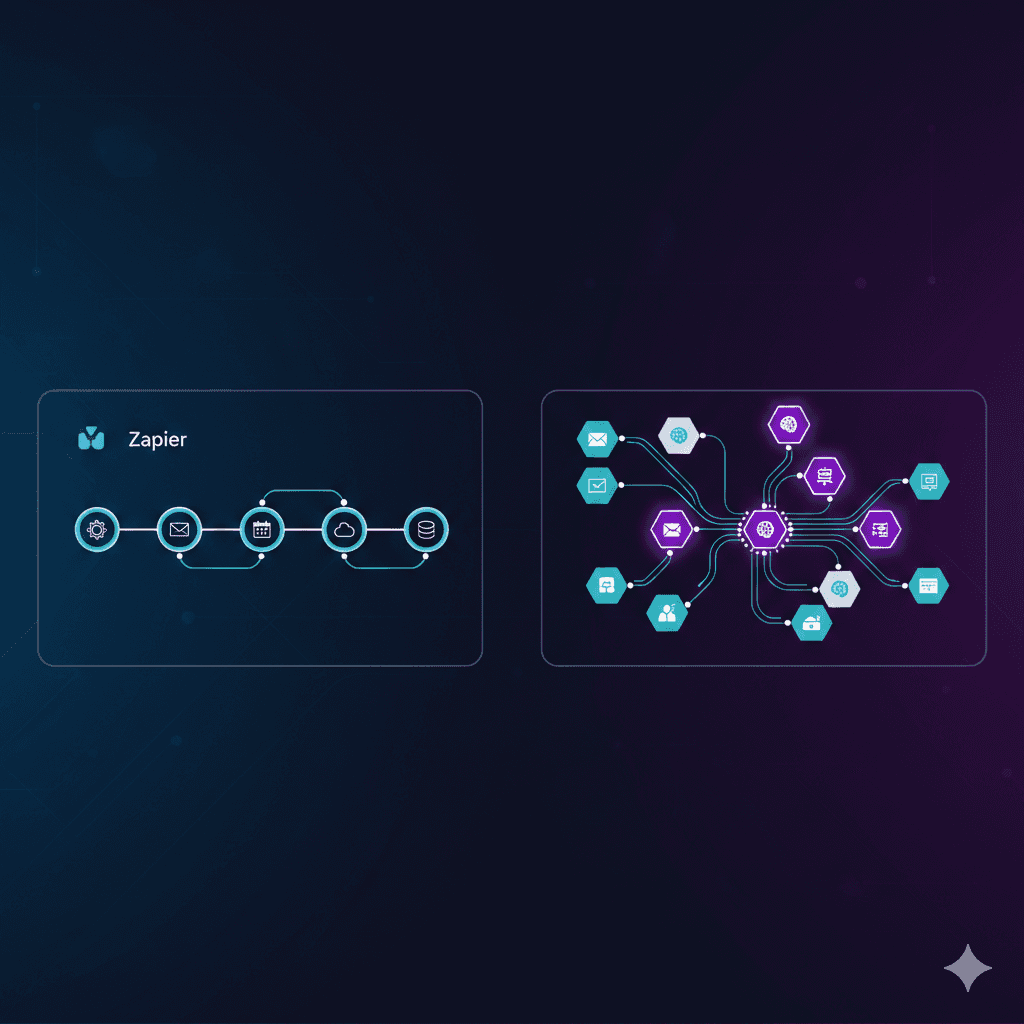
Zapier solved a real problem in 2014: connecting two apps without engineering. A decade later, the SMB marketing stack has 30+ tools, marketing workflows include unstructured content (emails, social, conversations), and the per-task pricing model penalizes scale. AI vs Zapier integration isn't a like-for-like comparison. it's a generational difference, and the cost gap of 60% reflects how much more efficient AI-native integration has become.
Five reasons drive the gap.
1. AI Handles the Unstructured Inputs Zapier Can't
Marketing inputs are inherently messy: customer emails, support replies, social mentions, form responses with free-text fields, lead notes from sales. Zapier can move structured data between apps, but it can't read an email and decide what to do with it. AI integration handles interpretation and routing in a single step, eliminating the multi-zap workarounds (with paid LLM steps in the middle) that Zapier-based marketing teams accumulate.
Cost impact: removing 4-6 chained Zaps per workflow saves $30-100/month per workflow.
2. Per-Workflow Pricing vs Per-Task Pricing
Zapier charges per task, which means every successful action. every CRM update, every email send, every status change. counts against your plan. Marketing workflows generate huge task volumes once they're working, and the pricing escalates fast. AI integration platforms typically charge per workflow run or per agent action, which scales much more favorably as volumes grow.
Cost impact: at meaningful volume (50K+ tasks/month), the platform cost difference is often 50-70% in favor of AI-native platforms.
3. Adaptive Workflows vs Brittle Chains
A 12-step Zap is a fragile thing. any upstream API change, edge case, or unexpected data shape breaks it loudly. The marketing team then spends hours diagnosing which step failed and why. AI integration workflows are more adaptive: the agent handles many surface-level changes without rewrites, and exception handling is part of the design, not an afterthought.
Cost impact: maintenance time drops 60-80%. For a marketing ops person spending 6 hours/week debugging Zaps, that's 4-5 hours reclaimed.
4. Cross-Tool Reasoning vs Sequential Logic
Modern marketing workflows often need to reason across tools. "is this lead worth a personal outreach given their behavior across the website, product trial, and email engagement?" Zapier handles this with elaborate filter chains and lookups. AI integration handles it natively: the agent reads from all relevant tools, applies the criteria, and acts.
The same workflow that takes 25 Zapier steps takes 2-3 AI integration nodes. Build time drops dramatically and the result is more flexible.
5. Native AI Capabilities vs Bolted-On AI
Zapier added AI features over 2023-2024 as bolt-ons. The integrations work, but the experience is fundamentally Zapier-with-AI-modules, not AI-native. Workflows that need genuine AI reasoning. content generation, classification, summarization, persona matching. are awkward to build in Zapier and elegant to build in AI-native platforms.
For marketing teams whose work is increasingly AI-driven, the platform choice has to be AI-first to keep up.
The 60% Cost Math for SMB Marketing Teams
For a typical 8-person marketing ops setup running 30+ workflows:
Zapier monthly cost (pro tier with reasonable task volume): $700-1,200/month.
Comparable AI integration platform: $300-500/month.
Maintenance time: 6 hours/week on Zapier, 1.5 hours/week on AI platforms.
Build time per new workflow: 4-8 hours on Zapier, 1-2 hours on AI platforms.
Stack the savings: $4-8K/year on platform cost plus another $20-30K in reclaimed labor. The 60% headline is conservative.
Where Zapier Still Has a Place
Truly simple two-app connections with stable APIs and low volume.
Quick prototypes before committing to a platform decision.
Long-tail integrations to obscure tools where AI integration platforms don't have native support.
The Migration Path
Don't try to rip out Zapier in week one. Instead:
Audit your existing Zaps. Identify the 20% generating 80% of the task volume.
Rebuild those high-volume workflows on the AI integration platform.
Migrate medium-volume workflows over the next quarter.
Leave low-volume Zaps as-is unless they're brittle. Cost is negligible.
Most SMB marketing teams complete the migration in 8-12 weeks with zero downtime.
What Marketing Leaders Should Demand
Native integration with your CRM, email platform, and analytics stack.
AI primitives. classification, generation, summarization. built in.
Per-workflow pricing that doesn't penalize success.
Observability that proves what the workflows are doing.
Templates for marketing-specific patterns (lead routing, abandoned cart, re-engagement).
Frequently Asked Questions
Will we lose any Zapier integrations in the move?
For mainstream marketing tools, no. For obscure tools, you may need a webhook bridge. Most teams find coverage equivalent or better.
How long does migration take?
For a marketing team with 30 workflows, 8-12 weeks of part-time effort. Higher-volume workflows pay back the migration cost within the first month.
What about our team's Zapier skills?
They transfer well. The mental model is similar; AI platforms are typically faster to learn than Zapier was.
How does Innflow compare on AI vs Zapier integration?
Innflow is built AI-native, prices per workflow rather than per task, ships templates for marketing-specific automations, and integrates with the marketing stack SMBs already run. delivering the 60% cost reduction with measurably less maintenance burden than Zapier.